Brent Rooker Athletics Breakout Slugger 2026 How AI Models Evaluate His Futures Value
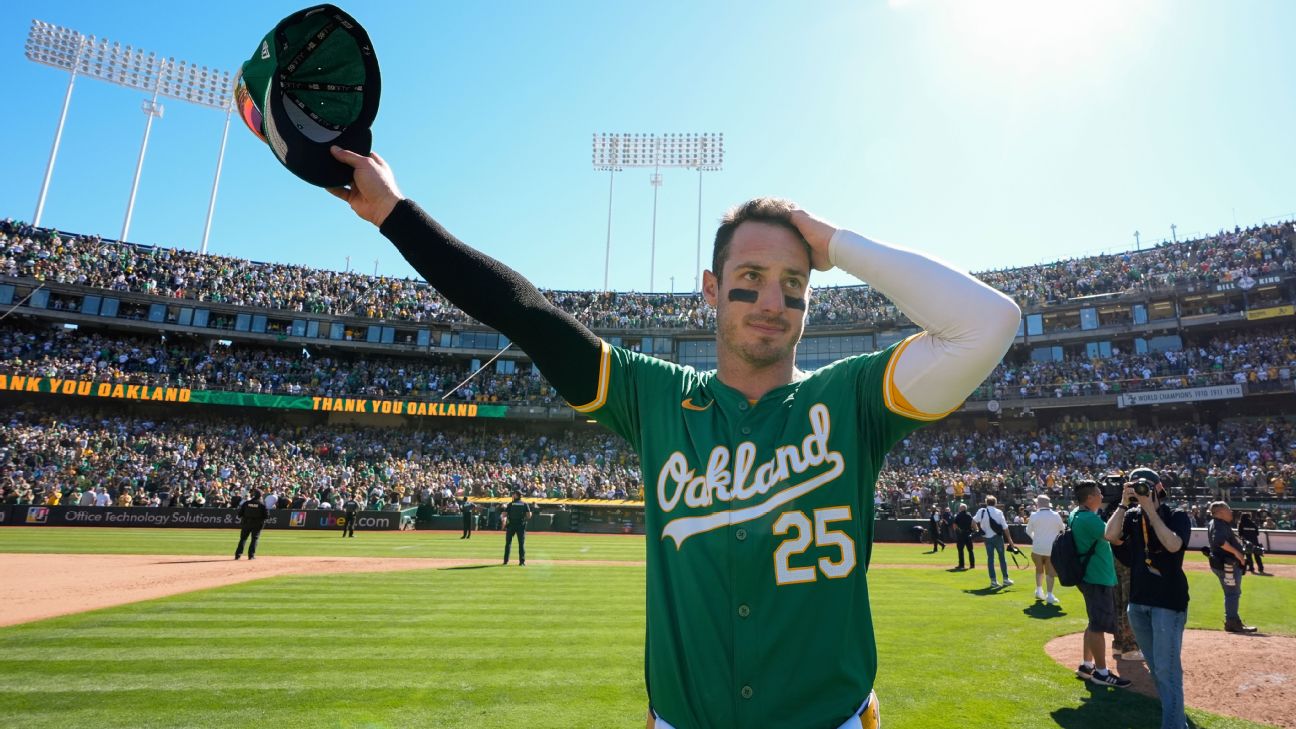
If you told someone three years ago that Brent Rooker would sign a $60 million extension and become the cornerstone of an Athletics franchise with legitimate playoff aspirations, they would have thought you were running a broken AI simulation. But that's exactly where we are as the A's prepare for their 2026 campaign in Sacramento, and Rooker's transformation from journeyman DH into a bonafide All-Star caliber hitter is one of the most fascinating case studies in modern player development. It's also the kind of story that teaches us a lot about how AI prediction models evaluate talent, and where traditional scouting sometimes gets it wrong.
The Numbers Behind the Transformation
Let's start with the raw production, because the numbers are genuinely impressive. In 2024, Rooker slashed .293/.380/.547 with 39 home runs, 112 RBI, and 11 stolen bases across 145 games, earning the American League Silver Slugger Award at designated hitter. That wasn't a fluke. In 2025, he played all 162 games and hit .262/.335/.479 with 30 home runs and 89 RBI. He's now posted three consecutive seasons with 30-plus home runs and an OPS north of .800.
What makes Rooker's trajectory so interesting from an AI modeling perspective is that it defies the typical player aging curve. He didn't break into the majors as a top prospect who hit the ground running. He was a late bloomer who found his swing in his late twenties, and the sustained production across multiple seasons now provides enough data points for prediction models to treat his performance as a stable baseline rather than an outlier.
How AI Models Would Evaluate Rooker's Profile
Modern AI prediction systems in baseball rely heavily on something called Bayesian updating, which is just a fancy way of saying the model adjusts its expectations as new data comes in. For a player like Rooker, the early career data, the struggles with the Twins, the minor league yo-yo, all of that created a prior expectation that said "replacement-level bat with power upside." Every season in Oakland (and now Sacramento) has been pushing that prior estimate upward.
After three full seasons of elite-level production, most well-calibrated AI models would now project Rooker as a true-talent .270 hitter with 30-35 home run power and an OPS in the .830-.860 range. The key variable is plate discipline. Rooker's strikeout rate has been a consistent concern, but his barrel rate and exit velocity numbers suggest genuine plus power that isn't dependent on lucky contact. That's the kind of underlying quality that AI models value highly, because it's more predictive of future performance than batting average alone.
For anyone new to AI-driven player evaluation, think of it this way: the model doesn't care that Rooker was a 35th-round draft pick or that he bounced between teams early in his career. It only cares about the quality of his recent batted ball data, his swing mechanics consistency, and how his peripherals project forward. And right now, those projections are very favorable.
The $60 Million Extension: Was It a Steal?
The Athletics locked Rooker up with a five-year, $60 million extension that buys out all three of his arbitration years plus two free agent seasons. The deal includes a $10 million signing bonus with annual salaries escalating from $2 million to $17 million, plus a $22 million club option for 2030 that vests based on plate appearance and MVP voting thresholds.
In an era where free agent sluggers routinely command $25-30 million per year, locking in a 30-homer bat at an average annual value of $12 million looks like excellent value. For context, Kyle Tucker signed a four-year, $240 million deal with the Dodgers this offseason, and Alex Bregman got five years and $175 million from the Cubs. Rooker isn't in that tier yet, but at a fraction of the cost, the production-per-dollar ratio is extremely favorable.
From an AI modeling standpoint, the contract structure is also smart because it accounts for uncertainty. The vesting option in 2030 essentially pays Rooker more if he sustains elite performance, but caps the team's downside if he regresses. That's good risk management, and it mirrors the kind of expected-value optimization that prediction models use when evaluating player contracts.
The Athletics' Lineup: Why Rooker Isn't Alone
One thing that AI prediction models consistently flag is that individual player performance doesn't exist in a vacuum. Lineup protection matters. And the Athletics have built a supporting cast around Rooker that makes his job easier.
Nick Kurtz won the AL Rookie of the Year award in 2025 after mashing 36 home runs and driving in 86 runs at just 22 years old. Catcher Shea Langeliers added 31 home runs of his own. Lawrence Butler provides speed and defense in the outfield. Max Muncy brings veteran presence at third base. This is a lineup that's projected as one of the better offenses in Major League Baseball heading into 2026.
The concern, and this is where the models pump the brakes a bit, is pitching. Luis Severino posted a 4.54 ERA across 29 starts in his first season with the A's, while Jeffrey Springs went 11-11 with a 4.11 ERA. That's a rotation that needs significant improvement if the offense is going to translate into wins. AI team-level projections typically weight pitching slightly more than offense because of its higher variance and injury risk, so the A's ceiling is capped until the rotation proves it can keep them in games consistently.
What This Means for Futures Bettors
If you're looking at Athletics futures for 2026, Rooker's presence is a stabilizing force that reduces offensive variance in the model. You know what you're getting from him: consistent power production, 150+ games played, and a middle-of-the-order anchor. The question marks are all on the pitching side.
For player prop futures, Rooker's over/under on home runs will likely sit in the 31.5-33.5 range. Given his three-year track record of 30+ homers and the fact that he's played 145 and 162 games in the last two seasons, the over has legitimate value if you believe in the durability data. AI models that incorporate health projections based on games played and days on the IL would give Rooker one of the highest availability scores among American League sluggers.
The broader lesson here for anyone getting into AI-driven sports analysis is this: the models aren't magic. They're just very good at identifying patterns that humans miss. Three years ago, most scouts and analysts had written off Brent Rooker. The data never did. His batted ball metrics, his exit velocity percentiles, his ability to punish mistakes in the zone, it was all there in the numbers, waiting for the right opportunity to manifest. The Athletics gave him that opportunity, and now the models treat him as one of the most dependable power bats in the game.
Sometimes the smartest bet isn't on the flashiest name or the biggest market. Sometimes it's on the guy who quietly put up 30 homers three years in a row and locked in at $12 million a year while everyone was paying attention to something else. That's the kind of edge that data-driven analysis is built to find.