If you are newer to betting baseball, two minus-money home favorites can look like the boring, expensive part of the board. Why pay -210 to win a small amount when a plus-money underdog pays so much more? The honest answer the AI keeps landing on is that a price is only expensive when it is wrong, and on Monday these two favorites are sitting on top of the biggest pitching gaps on the whole slate. This guide walks through what a moneyline is, why the starting pitcher matters more than almost anything else, and how the model sizes a bet on a minus price, using the real June 15 card.
What A Moneyline Actually Is
A moneyline is the simplest bet in baseball: you are just picking who wins the game, no run line, no total. A minus number is the favorite and tells you how much you must risk to win 100. A -210 favorite means you risk 210 to win 100, or 21 to win 10. A plus number is the underdog and tells you how much you win on a 100 risk. The bigger the minus number, the more the market believes that team should win. Your job is not to avoid favorites, it is to find the ones the market has priced correctly or even a little short.
Why The Starting Pitcher Is The Whole Ballgame
For a beginner, the single most useful habit is to look at the two starting pitchers before anything else. The starter throws the most important innings, and a big gap between the two arms moves the odds more than any other factor. The stat to learn first is WHIP, which is walks plus hits per inning pitched. It simply measures how many runners a pitcher lets reach base each inning. Lower is better, because runners are what turn into runs. A WHIP near 1.00 is very good; a WHIP near 2.00 means a pitcher is putting almost two men on every inning, which is a recipe for disaster.
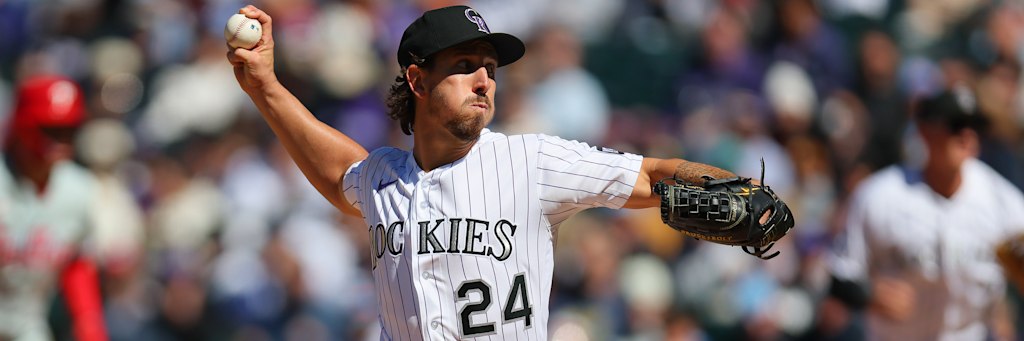
Now look at the Cubs game. Chicago starts Shota Imanaga, who has a 1.06 WHIP and a 4.44 ERA over 81 innings. Colorado counters with Michael Lorenzen, who is 2-8 with a 7.54 ERA and a 1.90 WHIP. That is a gigantic gap, almost a full extra baserunner per inning for the Rockies pitcher. The AI does not need a fancy model to see that edge, and neither do you. The better arm, at home, against a team that struggles on the road is exactly why the Cubs are -210.
| Game | Pick | Why the AI backed it |
|---|---|---|
| Rockies at Cubs | Cubs ML -210 (3u) | Imanaga 1.06 WHIP vs Lorenzen 1.90 WHIP, 7.54 ERA |
| Marlins at Phillies | Phillies ML -184 (3u) | Wheeler 0.85 WHIP, 2.22 ERA vs Gusto 6.00 ERA |
The Phillies Pick And A Lesson About Quiet Offenses
The second pick teaches a slightly more advanced idea. The Philadelphia Phillies are -184 at home behind Zack Wheeler, who has a sparkling 0.85 WHIP and a 2.22 ERA. That is one of the best run-prevention profiles in baseball, and Miami answers with Ryan Gusto, who has thrown only nine innings at a 6.00 ERA. So why is the price only -184 and not higher? Because the Phillies offense has been quiet, scoring just 4.01 runs a game on a .228 team average, the lightest bat in either of these two games.
Here is the lesson: a great pitcher can carry a weak offense, but it makes the bet a little riskier, because the team might only score two or three runs. The AI still backed it because Wheeler is so good at keeping the other team off the board that two or three runs is often enough. But it is worth knowing that this is a pitching bet, not a slugging bet. When you see a favorite with a great arm and a cold lineup, you are betting that the pitcher wins the game almost by himself.
How Unit Sizing Works On A Minus Price
A unit is just your standard bet size, whatever number lets you sleep at night. New bettors should keep a unit small, maybe one percent of a bankroll. Both of these picks are sized at 3 units, which for this model is a confident play but not its biggest. The reason both get the same 3 units is that the pitching edge, the home-field edge, and the road team's poor travel record all line up the same way in both games. When several signals agree, the model leans in a little harder.
One thing to understand about laying a minus price: the math is not symmetrical. On a -210 favorite, a win pays less than a loss costs, so you have to win these bets often to come out ahead. That is fine when the favorite truly is that much better, which is the whole point of checking the pitching gap first. It is not fine when you are laying a big number out of habit. The discipline is in only paying the price when the matchup earns it, and on Monday, both of these earn it.
| Matchup | Records | Road team note |
|---|---|---|
| Rockies at Cubs | COL 27-45 / CHC 37-35 | Rockies 13-25 on the road |
| Marlins at Phillies | MIA 36-36 / PHI 38-33 | Marlins 13-20 on the road |
What Pitching Edges Teach You About Futures
The same habit that helps you read a single game helps you read a season-long futures bet. A futures bet is a wager on something that settles far in the future, like a team's win total or a division title. The teams that beat their futures number over a full year are almost always the ones with deep, reliable starting pitching, because a good rotation wins the games a team is supposed to win, night after night, the same way Imanaga and Wheeler are favored to do on Monday. When you learn to spot a pitching mismatch in one game, you are training the exact instinct that tells you which teams are undervalued in the futures market.
The Honest Counterpoint For New Bettors
No favorite is a sure thing, and you will lose some of these. Baseball is the most unpredictable of the major sports on any single night; a great pitcher can have a bad first inning, a cold offense can stay cold, and a hot underdog like Miami at 8-2 over its last ten can absolutely win a game it should lose. That is why the model sizes at 3 units and not the whole bankroll. The goal is never to win every bet. It is to make bets where the price is a little shorter than it should be, over and over, and let the math work across a long season.
What Beats These Picks
The Cubs pick loses if Imanaga gives up a big inning or Lorenzen somehow holds the Cubs down. The Phillies pick loses if Wheeler comes out early or the quiet Philadelphia bats fail to score even three runs against Miami. Short favorites do not give you any cushion when they start slow. The AI is favored on both, but favored just means more likely, not certain, and respecting that gap is the difference between a bettor and a gambler.
Final Verdict
The June 15 AI card backs two home favorites built on pitching mismatches: the Chicago Cubs moneyline at -210 for 3 units behind Shota Imanaga against the Rockies and a 7.54-ERA starter, and the Philadelphia Phillies moneyline at -184 for 3 units behind Zack Wheeler's 0.85 WHIP. For more beginner-friendly model cards from this stretch, see our June 14 pitching-heavy Sunday guide, our June 13 team total under explainer, and the full model card archive to see how the AI has sized past plays.